 4 * Akai S1000 8-channel samplers
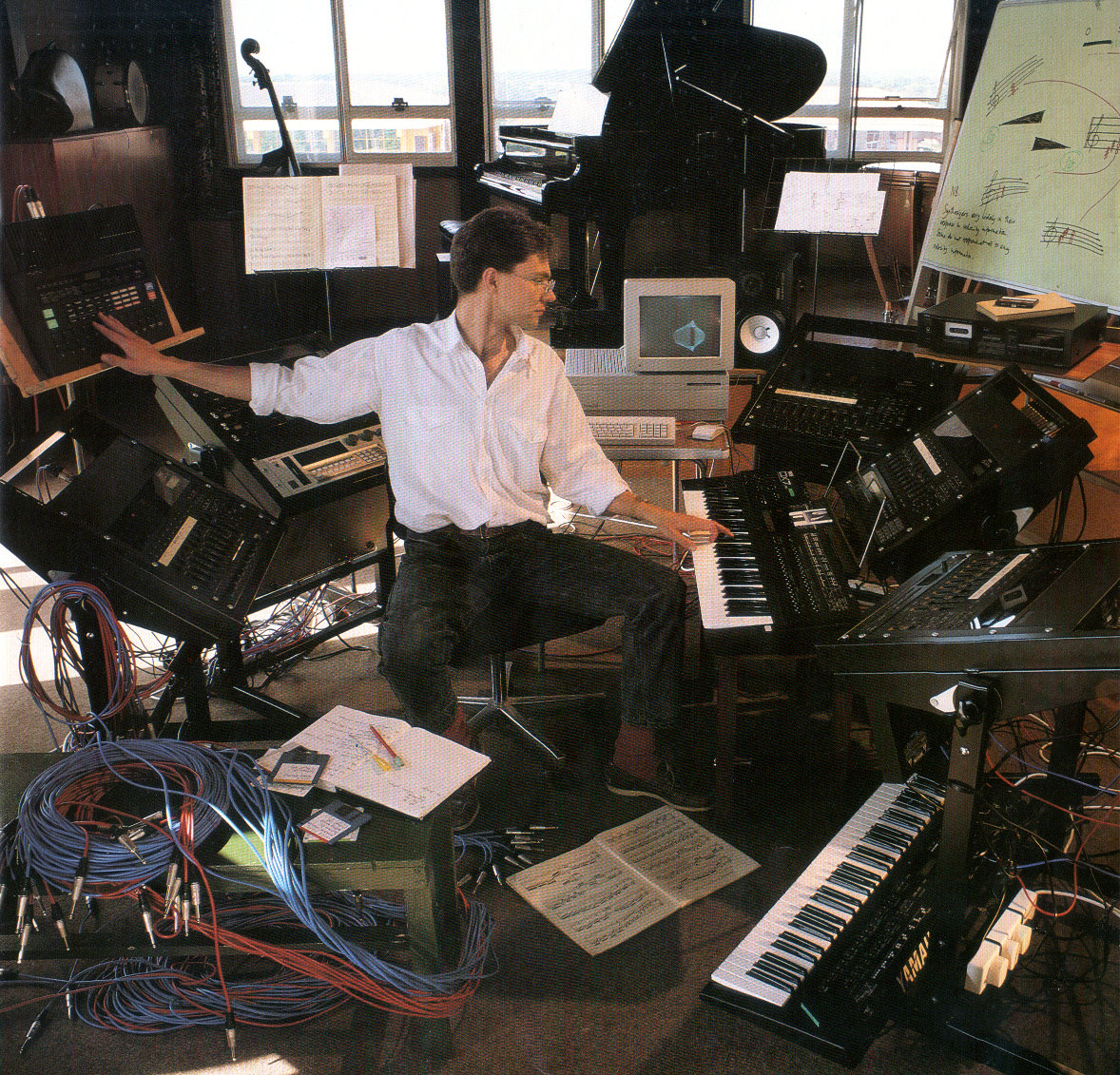
I dreamed up this project while studying Electronic Music at the University of Hertfordshire in 1993. Having the music department's extensive range of (then) state-of-the-art equipment at my disposal was a brilliant opportunity for experimentation. [This picture (below) from a few years before (not of me BTW) shows the shiny new digital gear making the grand piano in the background feel left out :-] The Music Studio had four workstations, each with an Akai sampler racked up with a Yamaha DMP7 digital mixer. So, ever the Gearslut, I longed to connect up all four together...! Then I realised a way to produce a rudimentary form of additive synthesis, using off-the-shelf hardware configured in a new way:
4 * Akai S1000 8-channel samplersEach Akai sampler could replay eight sine waves through its eight separate outputs, which were then mixed by the four Yamaha mixers, creating a 32-channel system. The samplers were set up with pitch offsets to play each of the first 32 harmonics above a fundamental played on a MIDI keyboard. The signals from the mixers were cascaded digitally and reverb was added to the final mix.
Thus, by moving a fader, the level of any harmonic could be adjusted. These changes could be recorded in real time as MIDI continuous controllers using a MIDI sequencer or computer along with the basic note data, to then be edited and replayed. The automated moving faders of the Yamaha mixer can recreate timbre changes and makes for a very tactile performance instrument, which had the uncanny effect of seeming like unseen hands at the controls... In fact I did make one piece called "Ghosts In The Machine" (sadly unrecorded), named after the cool TV programme, which exploited this spooky behaviour with Mexican waves of fader movements like a football crowd ;-) Obviously, this would never be fast enough to create complex real-world sounds such as a piano, but it excelled at rich textures and shifting spatial soundscapes. This was one expensive, but exquisite, pad machine! :-)
Since the Akai S1000 could handle 16-note polyphony, each sampler could in fact manage a two-note chord in each of its eight outputs. And the system could be instantly changed into other configurations, e.g., 16-harmonic 4-note polyphonic. I also designed a simpler setup without the Yamaha mixers, just using MIDI volume messages directly from the computer instead of the faders, but this wasn't half as much fun without the hands-on approach.
In order to keep the harmonics within the range of human hearing, a 32-harmonic system would have a 4.5 octave fundamental pitch range of 27.5Hz to 660Hz (A-1 to E3) with the corresponding 32nd harmonic ranging from 660Hz to 21120 Hz. While the higher notes would have sufficient harmonics within human hearing, once you lower the fundamental pitch, more harmonics are required than the system generates, and the 32nd harmonic descends into the mid-frequency range; this results in the low tones sounding less bright. Here's an example of the pitches and frequencies of the 32 harmonics of a low A:
As you can see, the first 32 harmonics of such a low-pitched note barely exceed the human vocal range, so really, many more partials than 32 would be desirable to fill the entire audible range with harmonics of such low notes.
Special effects included setting the pitch-bend range to be equal on each sine tone, such that the harmonic ratio was warped as the pitch bended, due to the logarithmic nature of pitch versus the linear pitch bend. This sounded amazing! For another effect I reconfigured the software so that each fader movement could retrigger a MIDI note-on at the held pitch, to create rapid percussive rolls that faded in or out.
Alas, I never got round to completing a full-scale composition using this groundbreaking setup - it took lots of work just patching it up every time, having to rewire the whole room of four workstations! Suddenly the end of term was upon us, and I'd run out of studio time :-( So tragically, these beautiful tones were never recorded, although simplified versions of the sampler keygroups and configurations were used in other finished pieces like Song Of The Goddesses and Deep Space.
The future...? I do still have the Akai S1000 program disks, and this gear is dead cheap now compared to the thou$and$ it cost back in 1993, but nowadays there are easier, more powerful and higher fidelity ways of achieving these aims, using just a computer with a large multi-fader controller. I do so wish someone would make a minimalist motorised fader box without all the extra buttons on, just sliders, ideally modular 8-channel units that can be daisychained with side-facing USB ports to join them together. If nobody ever makes such a thing, I suppose I'll have to get something custom made. Sit them atop a decent master keyboard, and you have the ultimate drawbar organ!
© copyright Malcolm Smith 2005-10-08 - last updated 2025-09-28